
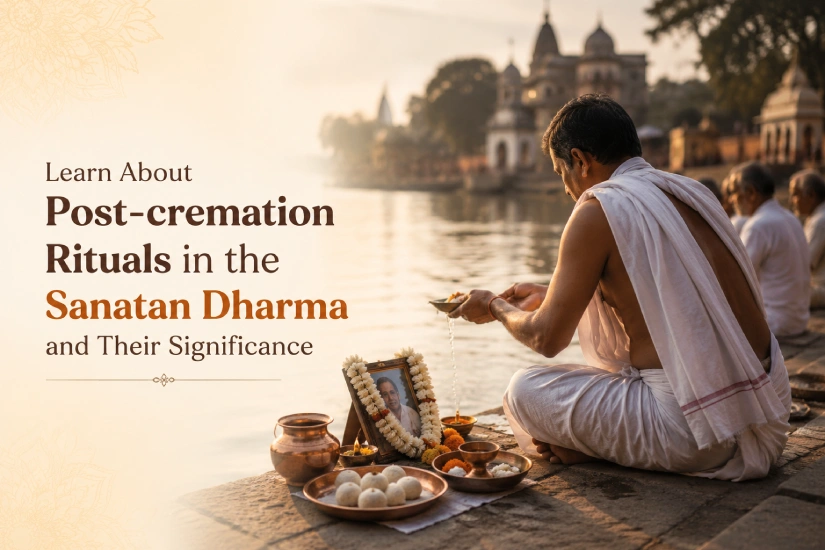
Learn About Post-cremation Rituals in the Sanatan Dharma and Their Significance
According to the Sanatan Dharma, death is not the end of human life, but merely a transition from one life form to another. That is precisely why, after cremating the body, a series of rituals are performed to ensure that the soul attains Moksha. These post-cremation rituals are extremely important and are performed with complete devotion under strict rules and regulations. The post-cremation rituals and customs are started right after leaving the Antim Niwas Noida Sector 94 and are mainly performed by the chief mourner or the Karta with the assistance of a priest or Pandit.
You will find more details on the post-cremation customs and rituals in this blog. It will help you understand the reason behind rituals and why they are performed. Therefore, offering you a more knowledgeable insight into the roots of life and death as described in the holy scriptures.
10 Important Post-cremation Rituals
The list below contains the 10 important post-cremation rituals and their significance, completing the final rites for the deceased.
Asthi Sanchayan (Collection of Ashes)
The cremated remains and bone fragments are collected, usually on the next day or within a few days after cremation. Ashes and remaining bones of the deceased are believed to hold a connection of the deceased soul to the material world. A credible Antim Niwas Noida Sector 94 will help you collect the Ashes hygienically and respectably.
Asthi Visarjan (Immersion of Ashes)
The ashes are immersed in a sacred river, sea, or other holy water body, often in places such as Haridwar, Prayagraj, or Varanasi. The Asthi Visarjan completes the human life cycle by offering the Asthi or the Ashes to a holy water body, returning the human soul to the five elements: earth, sky, fire, air, and water.
Mourning Period (Sutak)
Family members observe a mourning period, traditionally lasting 10 to 13 days, during which certain social and religious activities may be avoided. According to holy scripture, after death, the soul of the deceased remains in the mortal world for several days, and the sutak or the mourning period helps in the complete detachment.
Pind Daan
Offerings of rice balls (pindas) are made for the departed soul to aid its spiritual journey and honor ancestors. It is an extremely important ritual that ensures the soul does not wander in the mortal world and is free from every material tie.
Tarpan
Water mixed with sesame seeds is offered while reciting prayers for the peace and satisfaction of the departed soul. It is done along the Pind Daan on the same day in many cultures under the guidance of a priest.
Dashakriya / Tenth-Day Rituals
Special rites are performed around the tenth day after death to symbolically help the soul detach from the physical world. In multiple cultures, the rituals or customs performed in the Dashakriya are completed on the 13th day.
Terahvin (13th-Day Ceremony)
A prayer gathering and meal for relatives, friends, priests, and the needy is often organized to mark the end of the formal mourning period. It is believed that on the 13th day, after following all the previous rituals, the soul finally detaches itself from the material world and is now ready to transition into another life form.
Shraddha Ceremony
Rituals performed to honor the deceased and seek blessings from ancestors, often conducted annually. Friends, relatives, and close people are invited to collectively mourn the death of the deceased.
Annual Pitru Paksha Observance
Many families perform Shraddha and Tarpan during the Hindu fortnight dedicated to ancestors, known as Pitru Paksha. It is considered highly important in order to pay respect to the deceased and pay tribute to them.
Charitable Acts (Daan)
Donations of food, clothing, money, or other necessities are made in memory of the deceased as an act of merit and compassion. Daan or charity has high importance in the Sanatan Dharma and is said to bring prosperity and relief to the soul of the deceased.
Concluding Note from Hindon Cremation
Cremation rituals are as important as the post-cremation rituals. Therefore, Hindon Cremation, a credible Antim Niwas Noida Sector 94, offers hygienic conditions and ensures that every ritual and custom is performed honestly. We have educated priests who will help you bring peace to the soul of the deceased. From pure Antim Sanskar samagri to a clean cremation ground, our final rites services will help you bid a final goodbye to your deceased ones with respect.
To book a slot at Hindon Cremation Antim Niwas in Sector 94, please contact us. Our customer support staff will help you go through all the formalities with convenience and will make sure you are not burdened by the paperwork.
FAQs
Antim Niwas in Sector 94 provides comprehensive funeral support, including transportation of the deceased through hearse vehicles, cremation or burial arrangements, ritual assistance, documentation support, and post-funeral services. With Hindon Cremation, you will also get well-qualified priests to supervise the cremation process.
Yes, Hindon Cremation, a trusted Antim Nivas Noida Sector 94, offers 24/7 assistance and can quickly arrange the necessary facilities, transportation, and rituals during emergencies. All you need to do is reach out to us, and we will provide you with all the details that you need.
Yes, services are generally customized according to different religious traditions and cultural practices to ensure that all last rites are performed respectfully. Trusted Antim Niwas in Sector 94 takes full responsibility to make sure every ritual is completed with honesty.
Required documents for the cremation include:
- Death Certificate issued by a registered medical practitioner or hospital.
- Government-issued ID proof of the deceased (such as Aadhaar Card, Passport, or Voter ID).
- Identity proof of the next of kin or applicant arranging the funeral.
- Cremation or burial permit issued by the local municipal authority, where applicable.
- No Objection Certificate (NOC) or police clearance in cases of accidental, unnatural, or medico-legal deaths.
Depending on specific cases, there can be additional document requirements. Contact us –
Phone: +91 987 357 0938 to get full details.
Yes, Hindon Cremation Antim Niwas Noida Sector 94 offers electrical cremation services. It is considered an eco-friendly and highly cost-effective process where the body is cremated in an electric furnace. Our electrical cremation furnaces are hygienic and cleaned thoroughly to respect the deceased and bid them a proper goodbye.